
How to Prove Creative ROI
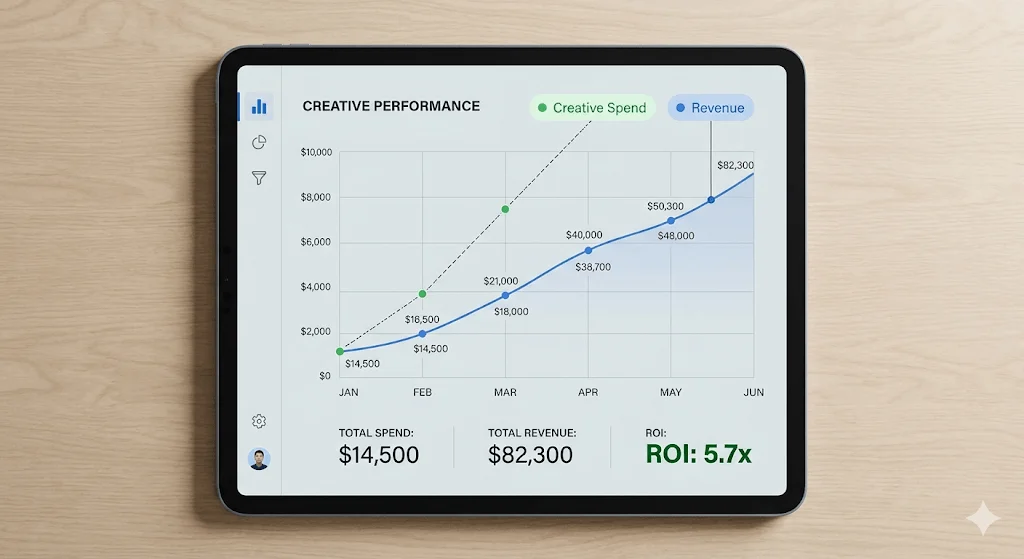
Most marketing leaders have been in this meeting. You’ve just presented a beautiful, award-worthy campaign. The work is inspiring. The team is proud. And then the CEO or CFO asks the question that stops the room: “That’s great. But what did it actually do for our growth?”
For too long, the link between creative and business outcomes has been fuzzy. We rely on vanity metrics like impressions and engagement, but struggle to connect the dots to what really matters: acquisition, retention, and revenue.
That gap is where budgets get cut and credibility gets lost. At Purple Stardust, we believe creative should be your most powerful growth lever, not your fuzziest expense. Here’s the exact framework we use to make that a reality.
The Shift: From Subjective ‘Good’ to Objective ‘Working’
The first step is to stop asking, “Is this creative good?” and start asking, “What is this creative’s job?” Every piece of creative—from a TV ad to a TikTok post—should have a specific job tied to a business problem. It might be to increase sign-ups for a new feature, reduce mid-funnel drop-off, or improve user onboarding.
When you define the job first, measuring its success is no longer a mystery.
The 5-Step Framework to Prove Creative’s Impact
This isn’t theory. This is a practical, repeatable process you can implement with your team and agency partners starting this quarter.
Image: A clean diagram illustrating the 5 steps below in a circular flow.
Alt Text: A circular diagram showing the 5 steps of the creative ROI framework: Business Problem, Funnel Mapping, Set KPIs, Instrument, and Review.
Step 1: Define the Business Problem, Not the Creative Ask
Most bad briefs start with a format: “We need a 30-second video.” A growth-focused brief starts with a number: “We need to reduce customer acquisition cost (CAC) by 15% in the next 90 days.”
Before any creative work begins, force your team to articulate the business problem in a single sentence.
- Bad: “We need a new social media campaign.”
- Good: “Our churn rate for users in their first 30 days is 40%; we need to get it below 25%.”
Step 2: Map Creative to a Specific Funnel Stage</h4>
Not all creative is designed to drive immediate sales. A top-of-funnel brand video has a different job than a bottom-of-funnel retargeting ad. Map every creative asset to a specific stage:
- Awareness: Is it designed to introduce your brand to a cold audience?
- Consideration: Is it meant to educate prospects and differentiate you from competitors?
- Conversion: Is it built to drive an immediate action (sign-up, purchase)?
- Loyalty: Is it for existing customers to encourage usage and advocacy?
Step 3: Establish Leading and Lagging Indicators
You can’t wait 6 months for revenue numbers (lagging indicators) to know if your creative is working. You need weekly signals (leading indicators).
- Example for a Conversion Campaign:
- Lagging Indicator: Customer Lifetime Value (LTV).
- Leading Indicators: Click-Through Rate (CTR), Cost Per Click (CPC), Add-to-Cart Rate, Conversion Rate.
If your leading indicators are green, you have a strong, data-backed reason to believe the lagging indicators will follow.
Step 4: Instrument Your Campaigns for Measurement
This seems obvious, but it’s where most teams fail. Ensure every campaign is built for measurement from the ground up.
- Use unique tracking URLs (UTMs) for every channel and creative variant.
- Set up conversion goals and event tracking in your analytics platform (like Google Analytics 4).
- For brand campaigns, use brand lift studies and control groups to measure impact. (For more on this, see this guide from HubSpot on measuring brand awareness).
Step 5: Run a Quarterly Creative Learning & Iteration Review
The goal isn’t to prove a single campaign was a success. The goal is to build an engine that learns and improves. Every quarter, sit down with your creative, growth, and data teams and answer three questions:
- What did we hypothesize would happen?
- What actually happened (based on the data)?
- What will we do differently next quarter because of what we learned?
Your Creative Should Be Your Best Growth Lever
Proving creative ROI isn’t about creating more spreadsheets; it’s about having more strategic conversations. By tying every creative decision back to a business problem and a set of metrics, you transform your creative department from a cost center into a predictable engine for growth. You can finally walk into that boardroom with a confident answer: “Here’s what our creative did for our growth. And here’s how we’re going to do even better next quarter.”Want to build a creative engine that’s wired for growth? Let’s talk about a diagnostic workshop for your team.

