
The Growth Marketer’s Creative Testing Framework
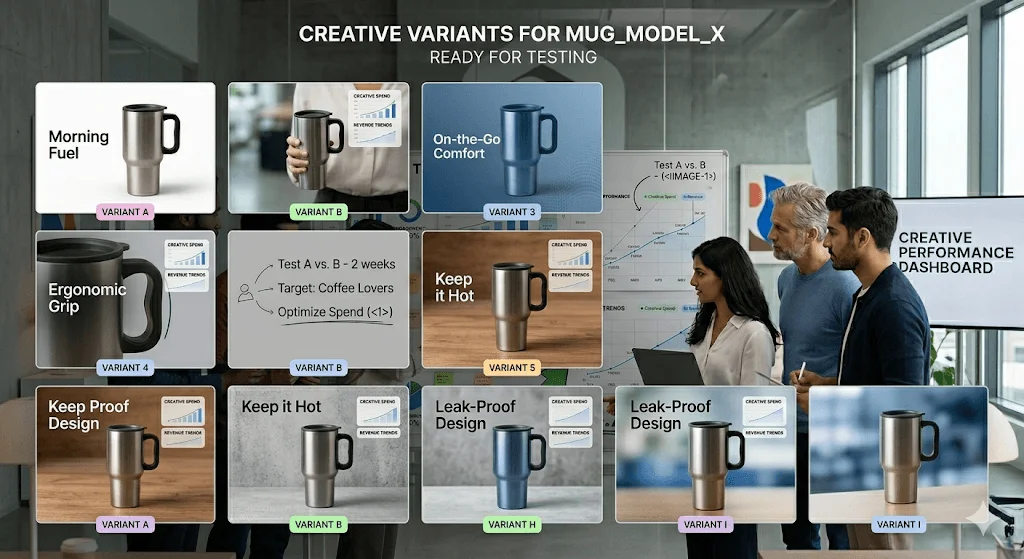
Your Customer Acquisition Cost (CAC) is creeping up. Your best-performing ad from six months ago has hit a wall. You ask your agency or internal team for “new creative,” and they deliver one beautiful, expensive “hero” video. You run it. It flops. Now what?
This cycle is frustrating, expensive, and all too common. The problem isn’t the creative team’s talent; it’s that the creative isn’t being developed within a system built for testing and learning.
For growth and performance marketers, creative isn’t just art—it’s a set of variables to be tested. Here is the exact framework we use to turn creative into a systematic lever for lowering CAC.
The Mindset Shift: From ‘Hero Creative’ to ‘Testable Variants’
Instead of betting everything on one perfect ad, the goal is to generate a portfolio of creative hypotheses in the form of testable variants. You’re not looking for one masterpiece; you’re looking for winning components that you can iterate on.
The 4×4 Creative Testing Framework
This framework forces you to be disciplined about what you’re testing and why. It’s built around the four elements that have the biggest impact on performance.
Image: A diagram showing four quadrants: 1. Hook, 2. Story/Angle, 3. Visual, 4. CTA, with examples in each.
Alt Text: A diagram of the 4×4 Creative Testing Framework, breaking down creative into Hook, Story, Visual, and CTA.
1. The Hook (First 3 Seconds)
In a world of infinite scroll, the hook is everything. If it doesn’t stop the user, nothing else matters. Your first test should always be isolating the hook.
- Test different hook types:
- Question Hook: “Is your team still using spreadsheets for project management?”
- Problem/Agitation Hook: “Your projects are chaos. Here’s why.”
- Bold Statement Hook: “This tool will save your team 10 hours a week.”
- Visual Hook: A surprising or visually arresting opening shot with no words.
Action: Create one core video, but shoot 3-4 different opening scenes. Test these first.
2. The Story / Angle
Once you have a winning hook, test the core value proposition or story you’re telling.
- Test different angles:
- Feature-led: “Our new dashboard gives you a 360-degree view.”
- Benefit-led: “Finally get clarity on who is doing what, by when.”
- Pain-point-led: “Stop wasting time in status meetings.”
- Social Proof-led: “See why teams from Google and Netflix use this tool.”
Action: Use your winning hook, but write and record 2-3 different scripts for the middle section of your ad.
3. The Visual Style
Visuals communicate as much as copy. Test different formats and styles to see what resonates.
- Test different visual approaches:
- UGC (User-Generated Content) style vs. high-production studio shoot.
- Animated explainer vs. live-action talking head.
- Product-focused screen recording vs. lifestyle shots of people using the product.
- Static image with bold text vs. a short video.
Action: Use your winning hook and story, but create it in 2-3 different visual formats.
4. The Call to Action (CTA)
The final step is to test the ask itself. Small changes in language can have a huge impact on conversion.
- Test different CTAs:
- “Sign Up for Free” vs. “Start Your Free Trial”
- “Learn More” vs. “See How It Works”
- “Get the Guide” vs. “Download Now”
Action: Run your winning creative combination but test 2-3 different end cards or button copy variations.
The Learning Loop: Review, Refine, Repeat
A framework is useless without a process for learning. Every 1-2 weeks, review your test results.
- Identify the Winner: Which variant achieved the lowest CPA or highest CTR? (Ensure you have statistical significance; tools like VWO’s calculator can help).
- Declare the Learning: “We learned that a question-based hook performs 30% better than a statement hook with this audience.”
- Iterate: The winner becomes the new control. Now, design your next batch of tests based on that learning.
This iterative process is how you systematically “discover” high-performing creative, rather than hoping you guess it right on the first try.
Build a Creative Engine That Learns and Wins
When you have a creative testing framework in place, you’re no longer dependent on flashes of brilliance. You have a reliable engine that consistently finds what works, improves performance, and gives you a powerful, scalable advantage over the competition.Ready to stop guessing and start winning with your creative? Let’s talk about building a performance creative engine for your brand.

