
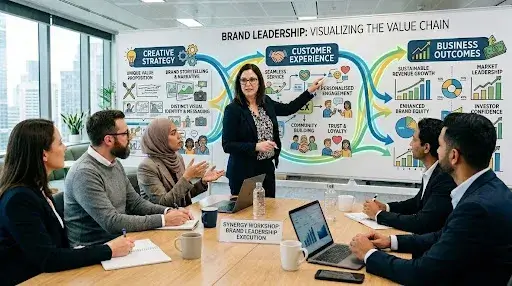
Brand creativity has entered a new era. For many years, organisations viewed creativity primarily as a marketing function responsible for producing campaigns, advertisements, social media content, and visual assets. While these outputs remain important, the role of creativity has expanded significantly. In 2026, creativity is no longer measured solely by how well it captures attention. It is increasingly judged by how effectively it influences customer decisions, strengthens competitive positioning, and contributes to long-term business growth.
This shift has important implications for executive leadership. Decisions about creativity can no longer be left entirely to marketing or design teams because the impact extends far beyond communications. Every creative decision influences how customers perceive the organisation, how employees understand the brand, how investors assess market positioning, and ultimately how the business performs commercially.
Many organisations still approach creativity tactically, evaluating campaigns based on aesthetics, engagement metrics, or short-term visibility. Meanwhile, the strongest brands are treating creativity as strategic infrastructure that supports innovation, customer experience, pricing power, and organisational growth. The gap between these two approaches continues to widen, creating significant competitive advantages for businesses that understand how creativity contributes to commercial success.
As customer expectations evolve and markets become increasingly crowded, executives must develop a broader understanding of how creativity functions within modern organisations. The businesses that will lead their industries in 2026 are unlikely to be those producing the highest volume of content. Instead, they will be the organisations whose leadership teams understand how creative strategy aligns with business objectives and guides every customer interaction.
This article explores the three most significant creative trends shaping 2026 and explains why leadership alignment has become one of the most important drivers of successful brand performance.
Creativity Has Become a Business Strategy Rather Than a Marketing Function
One of the biggest changes taking place across modern organisations is the repositioning of creativity from an operational discipline to a strategic business capability.
Historically, creativity was often introduced once strategic decisions had already been made. Leadership established commercial objectives, marketing developed campaigns, and creative teams produced the assets needed to support execution. Although this process delivered campaigns efficiently, creativity was rarely involved in shaping the broader business direction.
That model is becoming increasingly ineffective.
Today’s customers evaluate brands through every interaction they have with an organisation. They assess websites, digital experiences, customer service, advertising, packaging, events, product design, and corporate communications as part of one continuous brand experience. Creativity therefore influences far more than promotional activity. It shapes how customers interpret value, trust expertise, and decide whether a business deserves their investment.
Forward-thinking organisations now involve creative leaders much earlier in strategic planning because they recognise that customer perception is built long before individual campaigns are launched. When creativity is integrated into business strategy from the outset, brands communicate with greater consistency, build stronger emotional connections, and create experiences that reinforce long-term customer loyalty.
For executive teams, this means creativity should no longer be viewed as the final stage of execution. It should become part of strategic decision-making itself.
Trend One: Customers Expect Strategic Consistency Across Every Touchpoint
Customers no longer experience brands through a single campaign or communication channel. Instead, they interact with organisations across dozens of physical and digital touchpoints before making purchasing decisions.
A prospective customer may first discover a company through social media, visit its website several days later, read customer reviews, download a resource, receive email communications, speak with a sales representative, and finally visit a physical location before making a purchase. Each interaction contributes to the customer’s overall perception of the organisation.
This growing complexity has made consistency one of the defining characteristics of successful brands in 2026.
Consistency extends far beyond visual identity. It includes messaging, tone of voice, customer experience, strategic positioning, and the promises organisations make throughout the customer journey. Customers expect these elements to reinforce one another regardless of where or how they engage with the business.
When different departments communicate conflicting messages, uncertainty increases. Customers become less confident, decision-making slows, and trust begins to weaken.
Executive leaders therefore play an essential role in ensuring that organisational strategy provides a clear framework for every customer-facing function. Marketing, sales, customer service, operations, and creative teams should all reinforce the same central narrative rather than operating independently.
Brands that achieve this level of alignment create stronger recognition, improve customer confidence, and build reputations that remain resilient even in highly competitive markets.
Trend Two: Authenticity Has Replaced Volume as the Driver of Brand Growth
For several years, digital marketing rewarded organisations that produced increasing volumes of content across multiple platforms. Success was often associated with publishing frequency, social media engagement, and continuous visibility.
Although content remains essential, customer expectations have changed considerably.
Audiences have become more selective about where they invest their attention. Rather than rewarding brands simply for being visible, customers increasingly value organisations that communicate with clarity, relevance, and genuine expertise.
This means creative quality now matters significantly more than creative quantity.
Businesses that publish large volumes of generic content often struggle to differentiate themselves because their messaging resembles countless competitors pursuing similar strategies. Conversely, organisations that produce fewer but more thoughtful and strategically aligned communications frequently generate stronger customer trust and more meaningful commercial outcomes.
Authenticity has become particularly important because customers now have access to unprecedented levels of information before making purchasing decisions. They research extensively, compare alternatives, read reviews, and evaluate whether organisations genuinely understand their challenges.
Creativity therefore needs to demonstrate understanding rather than simply attract attention.
For executive leaders, this requires resisting the temptation to measure creative success through activity alone. Instead, organisations should evaluate whether their communications strengthen customer confidence, reinforce positioning, and support broader commercial objectives.
Trend Three: Data and Creativity Are Becoming Strategic Partners
One of the most significant developments shaping modern branding is the growing relationship between creative thinking and data-driven decision-making.
Some organisations continue treating creativity and analytics as separate disciplines. Creative teams focus on ideas while analysts concentrate on performance measurement. In reality, the most successful brands combine both perspectives throughout the creative process.
Data provides valuable insight into customer behaviour, market trends, buying patterns, and campaign performance. Creativity transforms those insights into experiences that influence perception and encourage action.
When these disciplines work together, organisations make stronger strategic decisions. Campaigns become more relevant because they respond to genuine customer needs rather than assumptions. Messaging becomes more effective because it reflects measurable behavioural insights. Creative investment also becomes easier to justify because leadership can clearly understand its contribution to business performance.
Importantly, data should never replace creativity.
Numbers explain what customers are doing, but they rarely explain why customers feel, trust, hesitate, or choose one brand over another. Creativity bridges this gap by translating analytical insight into human experiences that strengthen emotional connection and commercial value.
Executive leaders should therefore encourage balanced decision-making where evidence informs creativity and creativity brings evidence to life.
Why Leadership Alignment Determines Success

While these trends are reshaping the creative landscape, the greatest competitive advantage still comes from leadership alignment.
Many organisations possess talented creative teams, experienced marketers, and ambitious business strategies. However, these strengths often operate independently because different departments pursue different objectives or interpret success differently.
Marketing may focus on campaign engagement, creative teams on originality and artistic excellence, and leadership on profitability and growth. Each priority is valid in its own right. However, without strategic alignment, these competing objectives can result in fragmented decision-making that weakens the overall effectiveness of the brand.
Leadership alignment establishes one shared direction that connects every creative investment to measurable business objectives. Rather than approving campaigns based solely on visual appeal or marketing performance, executives evaluate whether creative decisions strengthen customer trust, support strategic positioning, and contribute to sustainable commercial growth.
This approach also improves organisational collaboration. Creative professionals gain greater clarity about the commercial purpose of their work, while business leaders develop a deeper appreciation for creativity as a strategic asset rather than a discretionary expense.
Most importantly, alignment enables organisations to respond more effectively to changing market conditions because every department works towards the same long-term objectives.
What Executive Leaders Should Be Asking
As creativity becomes increasingly central to business performance, leadership discussions should evolve beyond campaign reviews and marketing reports.
Instead of asking whether a campaign performed well on social media, executives should ask whether it strengthened customer confidence or improved competitive positioning.
Rather than evaluating the number of creative assets produced each month, leaders should examine whether those assets influenced purchasing decisions or reinforced long-term brand value.
Questions that deserve greater attention include:
- Does our creative strategy clearly support our business strategy?
- Are customers experiencing a consistent brand across every touchpoint?
- Is our creativity helping us differentiate ourselves in the marketplace?
- How does creative investment contribute to customer acquisition, retention, and loyalty?
- Are we measuring creative success through commercial outcomes rather than activity alone?
These questions shift organisational conversations away from operational reporting and towards strategic leadership.
Building a Creative Organisation for the Future

Preparing for 2026 requires organisations to rethink how creativity is developed, managed, and evaluated. Creative excellence will increasingly depend on collaboration rather than departmental ownership. Strategy, customer insight, marketing, operations, and creative execution must function as one connected system rather than isolated disciplines.
Investment should focus not only on producing campaigns but also on building stronger creative processes, clearer brand positioning, more consistent customer experiences, and deeper organisational alignment. Businesses that approach creativity this way are more likely to develop brands that remain relevant despite changing technologies, evolving customer expectations, and increasing competitive pressure.
Rather than reacting to trends, these organisations create enduring competitive advantages through consistent strategic thinking.
Conclusion
Brand creativity in 2026 is no longer defined by visual excellence alone. It has become a strategic capability that influences customer trust, competitive positioning, organisational growth, and long-term business resilience. As markets become more complex and customer expectations continue to evolve, executive leaders must recognise that creativity is not simply a marketing responsibility but a business asset that deserves strategic attention.
The organisations that will thrive are those whose leadership teams understand how creativity supports commercial objectives, aligns every customer touchpoint, and transforms insight into meaningful customer experiences. By embracing strategic consistency, prioritising authentic communication, combining creativity with data, and ensuring alignment across departments, businesses can build stronger brands that continue creating value well beyond individual campaigns.
At Purple Stardust, we help organisations transform creativity into a strategic advantage. Our team works with ambitious brands to develop creative strategies that align with business objectives, strengthen market positioning, and build lasting customer relationships through purposeful, commercially focused storytelling.
If your organisation is ready to move beyond campaign thinking and build a brand designed for long-term growth, book a strategy session with Purple Stardust today. Together, we can create a creative strategy that strengthens your brand, aligns your leadership team, and positions your business for sustained success in 2026 and beyond.

